Homeopathic Remedies for Injuries, Wounds & Pain Management
Discover essential homeopathic medicines for injuries, wounds, sprains, and post-operative pain. Learn the specific indications for Arnica, Hypericum, Ledum, Rhus Tox, and more.
Remedies by Type of Injury
Arnica
Indications: Black-and-blue, sore appearance and sensation; muscular tissue soreness.
Note: Do not use for open wounds/injuries as it may bring on erysipelas. Acts more on muscular tissue.
Calcarea carb
Indications: For persistent weakness after Rhus, over-lifting, and strains.
Patient Profile: Sweaty, blue-eyed, fat or lean, but always flabby; leaves large scars; neck enlarged somewhere; loose joints. Features a patient with a long scar in the carotid triangles and crooked legs. Pus is thin and runs easily.
Calendula Officinalis
Indications: Great remedy for wounds and open injuries.
Application: Aqueous Calendula locally; internally Q-3rd potency.
Hypericum Perforatum (St. John's Wort)
Indications: The "Arnica of the nerves." Concussion of the spine, nerve injuries (crushed fingers or toes, nail torn off), and hemorrhoids. Useful after surgical operations where wounds are exceedingly sensitive.
Specific Scenarios: Laceration of parts full of small nerves; spine injuries; injuries of the coccyx (like falling back and striking a stone, or during labor); falling backward down stairs and striking the back on a step.
Conditions: Coccydynia. Very painful, sore parts (occiput, coccyx, etc.).
Ledum
Indications: Punched/punctured wounds and animal bites (rat, cat bites, bee or scorpion stings, etc.).
Action: Prevents shooting pains; give it at once. Use if the pain is a dull aching in the wound. (Note: If pain shoots from the wound up the nerve of the arm, use Hypericum instead).
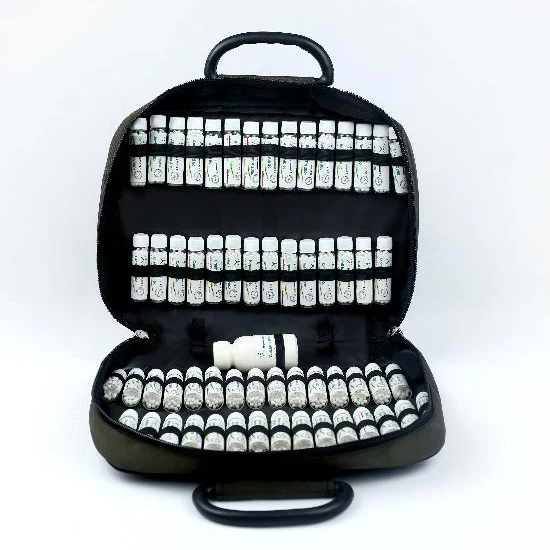 Homeomart
Homeopathy First Aid Kit – 60 Remedy Emergency Travel & Family Wellness Kit
Buy NowRhus (Poison Ivy)
Indications: Rheumatic or paretic effects, over-lifting, strains of muscles and tendons, sprains, and ill effects of getting wet.
Symptoms: Rheumatic feelings coming on in every storm (often wearing off on continued motion). Pain and stiffness are worse on commencing to move, but continued motion and warmth relieve. Patient cannot bear cold air. Acts more on ligaments than muscles. Can involve formation of pus, intense pain, dark red swelling, general prostration, and septicemia.
Relationships: Bryonia complements Rhus; Apis is inimical. Best medicine for dislocations.
Ruta
Indications: Bruises about cartilages and joints.
Staphysagria
Indications: Clear-cut (incised) wounds/injuries made with a sharp instrument. Antidote to stretching (e.g., when the urethra has been stretched for stone in the bladder, causing patient distress, screaming, crying, cold sweat, hot head).
Surgical Note: Coldness, congestion of the head, and rending/tearing pains from stretching sphincters or tearing parts for operations. Especially valuable for controlling subsequent pain after severe operations upon the abdomen.
Strontium carb
Indications: Great prostration, coldness, oozing of blood, and cold breath after a surgical operation.
Remedies for Specific Symptoms & Post-Operative Conditions
Shock & Coldness
Camphor: Main feature is coldness.
Carbo-veg: Indicated by blueness.
Veratrum-album: Indicated by well-known cold sweat on the forehead and body.
Haemorrhage Effects
Aconite: Indicated by distressing restlessness and tossing about (useless if this specific mental state is absent).
Arsenic: Controls savage thirst immediately following blood loss.
China: Invaluable when acute symptoms have subsided.
Pain Control in Wounds/Stumps
Coffea: Intolerable, tearing pains in a wound or stump.
Aconite: Moderate pain with great restlessness.
Ledum: Sharp, darting pains along the line of the incision.
Wound Characteristics & Pus Profiles (Silicea vs. Hepar)
Silicea: Patient is cold (objectively and subjectively) with sluggish movements; wounds are slow in coming and slow in healing; pus is offensive.
Hepar: Attacked more quickly, heals more rapidly, wound is more active, and discharges are less offensive.
Phosphorus: Sensitive wound; bleeds freely in a stream; appears angry, fiery red, or pale. Patient is tall, spare, red-headed, freckle-faced, constipated, with indefinite bladder trouble.
Lachesis: Blue wound; big veins; possible slough/much dead tissue; worse mornings; tendency to form sinuses; pus is thick and flaky.
Aetiology & Observations on Disease Suppression
Suppression of Conditions: The suppression of skin diseases, drying up of eruptions and ulcers, and ignoring the true nature of local diseases accounts for much mysterious illness today.
Cancer & Prevention: Careful history-taking in cancer patients often reveals evidence of suppression (e.g., a high proportion of mammary cancer cases follow the suppression of uterine discharges). While these may be coincidences, universality suggests an underlying law.
The Physician's Duty: Prevention is one of the highest duties of medicine. A rational treatment cannot leave destruction in its track; true method consists in preventing what cannot be cured.
Remedia earns a small commission on purchases made through these links, at no extra cost to you.