Homeopathy vs Allopathy: The Complete Guide to Choosing Your Healing Path
Discover the core differences between homeopathy and allopathy. Learn when to trust natural remedies and when to rely on conventional medicine for true healing.
Don't self-treat a serious condition
Conditions like this deserve a doctor's eye. Start an online consultation and get a treatment plan suited to you.
Start ConsultationAs a homeopathic practitioner, the most common question I encounter in my clinic is simply: “How is this different from the medicine my regular doctor gives me?”
It is a vital question. We are living in an era where patients are taking back control of their health, seeking options that do more than merely silence their symptoms. To make informed choices about your well-being, you need to understand the fundamental philosophies, strengths, and appropriate applications of both Homeopathy and Allopathy (conventional modern medicine).
Here is a comprehensive look at how these two medical paradigms compare, where they shine, and how you can navigate them to achieve true, lasting health.
The Core Difference in Method: Two Paths to Healing
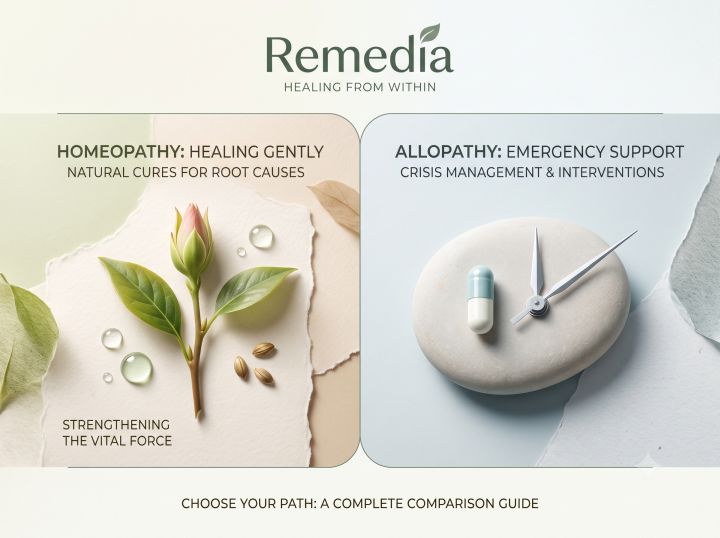
The divergence between homeopathy and allopathy lies at the very foundation of how they view disease and the human body.
The Allopathic Method: Allopathy operates on the principle of opposites. If you have inflammation, you are given an anti-inflammatory. If you have a bacterial infection, you receive an anti-biotic. If you have a fever, an anti-pyretic lowers it. The focus is primarily on the physical disease, the isolated organ, and the rapid suppression of uncomfortable symptoms. It treats the body much like a machine with broken parts that need to be chemically forced into submission.
The Homeopathic Method: Homeopathy operates on the principle of Similia Similibus Curentur—like cures like. Rather than suppressing symptoms (which we view as the body’s intelligent effort to heal itself), homeopathy uses highly diluted, potentized natural substances that would cause similar symptoms in a healthy person. This gentle micro-dose acts as a catalyst, stimulating the body's innate "vital force" to heal itself. Millions of patients globally have experienced these profound results firsthand. Ultimately, if the proof of the pudding is in eating, it is impossible to deny that like cures like.
Homeopathy treats the person hosting the disease, not just the disease itself, taking into account physical, mental, and emotional symptoms to prescribe a highly individualized remedy.
What Each Approach Treats Well
Every medical system has its rightful place. Understanding their respective strengths allows you to choose the safest, most effective route.
The Strengths of Homeopathy
Homeopathy excels at addressing chronic, recurring, and psychosomatic conditions. Because it addresses the root susceptibility of the patient rather than just masking the pain, it offers profound healing for:
Chronic Diseases: Asthma, eczema, arthritis, migraines, and irritable bowel syndrome (IBS).
Mental & Emotional Health: Anxiety, depression, grief, and chronic stress.
Pediatric Care: Colic, teething, recurrent ear infections, and behavioral issues in children (offering a gentle alternative without harsh side effects).
Autoimmune and Hormonal Imbalances: Where conventional medicine often relies on lifelong steroids or hormone replacements.
Homeopathy is particularly exceptional when there is time to wait and allow the body to heal naturally. When a condition is not immediately life-threatening, opting for a natural, non-toxic cure prevents the accumulation of chemical side effects and strengthens the immune system for the future. For holistic, long-term vitality, I proudly consider Homoeopathy safer and superior medicine.
The Strengths of Allopathy
Conventional medicine is the undisputed champion of emergency interventions and crisis management. It is structurally designed to save lives in acute, time-sensitive situations:
Trauma and Emergencies: Car accidents, severe burns, heart attacks, and strokes.
Surgical Interventions: Structural issues that require mechanical repair, such as a ruptured appendix or a complex fracture.
Life-Threatening Infections: Sepsis or acute bacterial outbreaks where immediate pharmacological intervention is a matter of life and death.
Common Misconceptions About Homeopathy
Misconception 1: "It’s too slow." The Reality: Homeopathy can act remarkably fast in acute conditions (like a sudden fever or a bee sting). However, for chronic diseases that have taken years to develop in the body, reversal takes time. Allopathy might offer a pill that stops your migraine in twenty minutes, but you will have to take that pill every week for the rest of your life. Homeopathy takes time to work because it is actively healing the underlying susceptibility, aiming for a permanent cure, not temporary relief.
Misconception 2: "It's just water / the placebo effect." The Reality: Skeptics often point to the high dilutions in homeopathic remedies. Yet, clinical practice, veterinary homeopathy (where animals cannot experience placebo), pediatric successes, and emerging research into nano-pharmacology continually demonstrate its efficacy. The energetic imprint of the substance communicates with the body on a cellular level, triggering an undeniable healing response.
Misconception 3: "You have to 'believe' in it for it to work." The Reality: Homeopathy is a medical science, not a belief system. Just as gravity works whether you believe in it or not, homeopathic remedies stimulate the vital force regardless of the patient's initial skepticism.
The Integrative Approach: When Patients Combine Both
As a practitioner, my goal is your health, not ideological purity. There are times when integrating both systems is not only reasonable but wise.
Patients often combine both when transitioning away from heavy conventional drugs. For example, a patient on long-term allopathic blood pressure medication should never stop their prescription cold turkey. Instead, they can begin homeopathic treatment to address the root causes of their hypertension (stress, constitution, systemic imbalance). As the body heals and blood pressure naturally normalizes, their allopathic doctor can safely and gradually taper down their conventional medication.
Furthermore, if a patient is undergoing aggressive conventional treatments (such as chemotherapy or intensive surgeries), homeopathic remedies like Arnica or Nux Vomica are brilliantly effective at mitigating the severe side effects, managing pain, and accelerating recovery times without interfering with the allopathic drugs.
The Final Verdict
Your body is not a battlefield to be conquered by chemicals; it is a complex, intelligent ecosystem that sometimes needs a gentle, natural nudge back into balance.
By understanding the distinct roles of these two systems, you can build a comprehensive healthcare strategy that prioritizes long-term wellness over short-term suppression. A good guideline to remember is: Homoeopathy as the general rule; allopathy as a last resort.
Choose the path of deep, restorative healing whenever time and circumstances permit, and trust in your body's remarkable capacity to heal itself.
Don't self-treat a serious condition
Conditions like this deserve a doctor's eye. Start an online consultation and get a treatment plan suited to you.
Start Consultation