Calculate Your BMI
A quick, interactive BMI calculator — plus what the number does (and doesn't) tell you about your health.
Body mass index (BMI) is a quick, widely used screening number that relates your weight to your height. It's not a diagnosis, and it doesn't measure body fat directly — but as a starting point for a conversation about weight and health, it's hard to beat for simplicity. Enter your height and weight below to see where you fall.
Formula: 65 ÷ 1.70² = 22.5
BMI is a screening measure, not a diagnosis — it doesn't account for muscle mass, bone density, or body composition. Talk to your doctor about what a healthy weight looks like for you.
What the categories mean
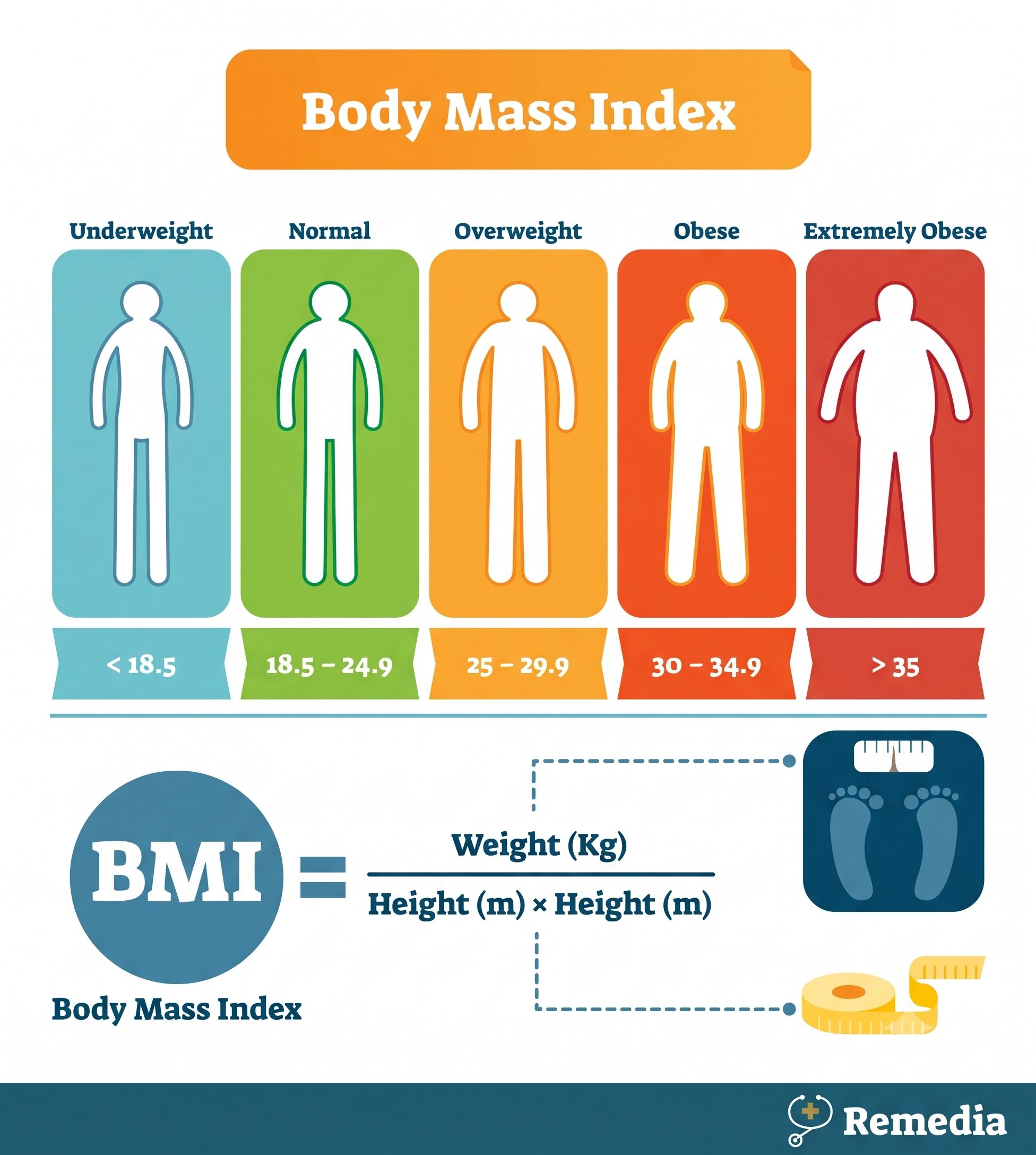
Once you have a number, here's how it's generally read:
BMI | Category |
|---|---|
Below 18.5 | Underweight |
18.5 – 24.9 | Healthy weight |
25.0 – 29.9 | Overweight |
30.0 and above | Obesity |
How it's calculated
In metric units, BMI is your weight in kilograms divided by the square of your height in metres. In US units, it's your weight in pounds divided by the square of your height in inches, multiplied by 703. Both give the same result — the calculator above handles either.
What BMI doesn't tell you
BMI looks at height and weight alone. It can't tell the difference between muscle and fat, so a very muscular person may show a higher number without carrying excess fat, and it doesn't account for bone density, body composition, or where fat is carried on the body — factors that matter for actual health risk. It also isn't designed for children, pregnant women, or people over 65, and the standard cut-offs don't map onto every population equally well.
Use it as one data point, not a verdict. If your number surprises you, or you're not sure what it means for you specifically, that's exactly the kind of thing worth raising in a consultation rather than settling with a calculator.
General information only — not a substitute for a full consultation or advice from your regular physician.