Understanding Ovarian Cysts: A Complete Homeopathic Guide to Apis, Sepia, and Lachesis
Discover the natural homeopathic approach to managing ovarian cysts. Explore the detailed symptom profiles, constitutional types, and healing properties of top remedies like Apis Mellifica, Sepia, and Lachesis.
Don't self-treat a serious condition
Conditions like this deserve a doctor's eye. Start an online consultation and get a treatment plan suited to you.
Start ConsultationUnderstanding Ovarian Cysts
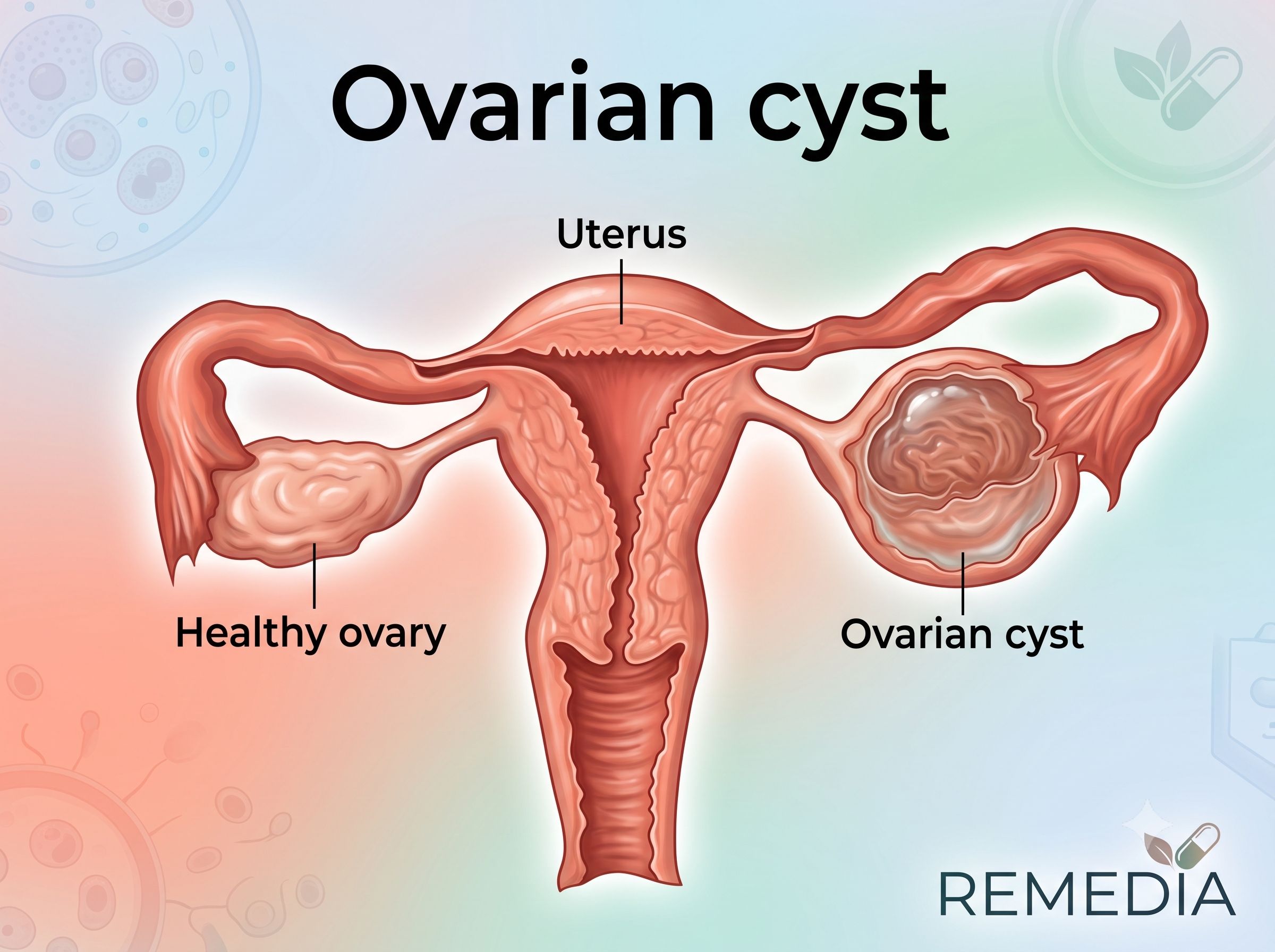
Ovarian cysts are fluid-filled sacs similar to blisters. They are common among women during their reproductive years, are generally harmless, and frequently resolve naturally without any medical treatment. While most functional cysts are completely asymptomatic, they can occasionally cause dull, aching pelvic pain, bloating, or sudden sharp pain if the cyst undergoes torsion (twisting) or ruptures.
The normal physiological function of the ovaries is to produce an egg each month. During the process of ovulation, a cyst-like structure (a follicle) forms inside the ovary. This mature follicle ruptures to release an egg during ovulation, after which a corpus luteum forms from the empty follicle. If pregnancy does not occur, the corpus luteum naturally dissolves. Sometimes, this process does not conclude appropriately, resulting in the most common type of ovarian cyst: the functional ovarian cyst.
Abnormal ovarian cysts—such as dermoid cysts, cystadenomas, endometriomas, and polycystic ovarian disease (PCOD)—often occur as the result of an underlying imbalance of the female hormones, estrogen and progesterone.
Primary Therapeutics
For general therapeutic support:
Take Apis Mellifica-Q: 1 drop in a cup of water twice daily.
Apis Mellifica is specifically indicated for cysts that present with stinging, burning pains, often accompanied by localized cellular swelling or edema, and it exhibits a profound affinity for the right ovary.
Sepia: The Deep-Acting Anti-Psoric
Sepia is a wonderful anti-psoric remedy with a profound action on nearly every tissue and organ of the body. Sepia is derived from the inky juice of the cuttlefish, a substance that conceptually mirrors the sluggish circulation, physical exhaustion, and dark venous congestion seen in patients requiring this remedy. Like most remedies of its class, its medicinal effect is long-lasting; a single dose is often sufficient for many weeks.
It expends its energy first upon the brain and nervous system, deranging the "vital force" (as Hahnemann termed it) and thereby producing organic changes. This tendency toward organic tissue change is frequently first seen on the skin via discolorations like the "yellow-saddle" across the nose, "moth patches," and characteristic herpetic eruptions. Because of this deep action, it has the ability to cure malignant diseases; epithelial cancer has been reported by Dunham and others as coming within its healing influence.
Patient Constitution & Characteristics:
Adapted to women with dark hair and eyes, rigid muscular fiber, and a mild disposition, but who are easily offended, irritable, and often vehement.
Inclined to abdominal adipose (fat) accumulation, especially after childbearing.
Sallow, bleached facial appearance with yellow patches on the chest, face, and conjunctiva.
Key Clinical Symptoms:
Climacteric Troubles: Hot flushes, sudden accessions of heat followed by momentary sweat, disposition to syncope (fainting), especially when based on portal congestion.
Pelvic & Uterine: Prolapsus with an intolerable "bearing down" sensation, as if the contents of the pelvis would extrude from the body. This is distinctly relieved by sitting down or crossing the limbs. Paralytic affections of pelvic and abdominal viscera.
Menses & Hemorrhage: Never regular; too early and profuse, or too late and scanty. Hemorrhage during the climacteric or pregnancy (especially the 5th and 7th months) features dark, sluggish blood.
Sensations: Coldness on the vertex; cold feet and ankles. Sensation of a ball in inner parts (during menses, pregnancy, lactation, or with constipation, diarrhea, hemorrhoids, leucorrhea).
Pain Modalities: Pains extend from other parts to the back, attended with shuddering (not chilliness), and are relieved by motion or pressure.
Headache: Periodic, boring pain from within outward, with nausea and vomiting. Congestive headaches driven by mental excitement force the patient to leave bed and walk the floor. The head feels full, throbbing, and ready to burst. Relief is obtained only by pressing the sides of the head with both hands, binding it tightly, and walking rapidly (excluding Belladonna).
General Modalities & Nervous System:
Worse (<): At the new moon, in snowy or foggy weather, during/before a thunderstorm. Worse on awakening from deep sleep. Cannot wear tight garters or rings due to swollen extremities.
Better (>): After sufficient sleep, toward evening, and from gymnastic exercises (which relieve morning flatulence).
Nervousness: Spasmodic head shaking (patient remains conscious, triggered by emotions). Extreme restlessness; cannot sit still, bites nails, scratches head, pulls hair. Nighttime restlessness; cannot lie on the back.
Lachesis: The Left-Sided Venom Remedy
Lachesis is prepared from the venom of the Bushmaster snake (Lachesis muta), and its constitutional symptom profile strongly reflects the toxicological effects of this venom, including rapid tissue breakdown, extreme hyperesthesia, and intense vascular congestion.
Patient Constitution & Characteristics:
Suitable for women with dark eyes and complexion, or red hair and freckles.
Inclined to low spirits with an indolent, choleric, or melancholic temperament.
Often thin and emaciated, changed deeply both mentally and physically by the effects of the disease.
Key Clinical Symptoms:
Climacteric Troubles: Prominent when mental or nervous symptoms predominate. Hot flushes, burning vertex headache, hemorrhoids, and hemorrhages after the cessation of menstrual flow.
Left-Sided Affinity: Paretic (paralytic) symptoms primarily on the left side, including left-sided apoplexy.
Menses: Regular as clockwork (punctual almost to the hour), but too short and feeble. Crucial characteristic: Pains are distinctly relieved by the menstrual flow.
Sensitivities: The uterine region is extremely sensitive to touch; the patient absolutely cannot bear clothing to touch her waist or abdomen.
Pelvic & Pain Sensations: Prolapsus with bearing down, labor-like pains. Neuralgic, tearing, stitching, pulsating, and burning pains. Sensation of worms crawling in the heels, bladder, or rectum. Beating sensation as of little hammers in the rectum, temples, and vertex.
Pathology & Modalities:
Skin & Tissues: Bullae that are yellow, purplish, or dark from bloody serum. Carbuncles, malignant pustules, and bedsores with dark or black edges (indicating malignancy).
Hemorrhage: Hemorrhagic diathesis; small wounds bleed excessively. Blood is lumpy, black, or acrid.
Worse (<): In the Spring, during extremes of heat or cold, and from the sun's rays. Worse from noon until midnight.
Sleep Aggravation: Symptoms are decidedly worse after sleep; the aggravation wakens the patient, or they "sleep into" the aggravation (a profound mental and physical condition).
Prescribing Contraindication
In the rigorous study of homeopathic remedy relationships, certain medicines clash violently in their energetic frequencies. Sepia and Lachesis are inherently incompatible. Like most animal poisons, they should rarely follow each other in a treatment plan and must never be administered together.
Don't self-treat a serious condition
Conditions like this deserve a doctor's eye. Start an online consultation and get a treatment plan suited to you.
Start Consultation