Ankylosing Spondylitis: Symptoms, Management & Homeopathic Treatment
Understand the key differences between normal aging spondylosis and ankylosing spondylitis. Discover effective homeopathic remedies, symptom management, and the crucial role of daily exercise in relieving spinal stiffness and joint pain.
New to homeopathy? Start here →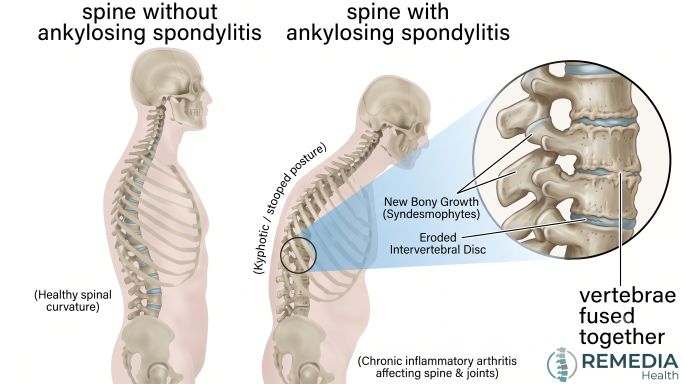
Don't self-treat a serious condition
Conditions like this deserve a doctor's eye. Start an online consultation and get a treatment plan suited to you.
Start ConsultationSpondylosis is not a disease; it is a normal aging process that occurs in the spine, typically becoming symptomatic only after a patient reaches 35 years of age. Spondylosis is essentially osteoarthritis of the spine caused by mechanical wear and tear over time, making it fundamentally different from autoimmune spinal conditions.
When diagnosing spinal issues like a disc prolapse, a Magnetic Resonance Imaging (MRI) scan is definitely superior to a standard X-ray. However, even with clear MRI evidence of a disc prolapse, the imaging must always be correlated clinically with the patient’s physical symptoms to ensure accurate treatment. Furthermore, to address a common misconception: masturbating does not lead to spinal degeneration or neck pain.
Understanding Ankylosing Spondylitis
Ankylosing spondylitis is a highly painful, progressive rheumatic disease that mainly targets the spine. It is a condition that cripples several people all over the world. Males are more prone to developing the disease than females, with the onset most commonly occurring between the ages of 15 and 35 years. Ankylosing Spondylitis is strongly linked to genetics, specifically the presence of the HLA-B27 gene marker, which is found in the vast majority of patients suffering from the condition.
The disease is driven by persistent inflammation in the joints between the vertebrae and the sacroiliac joints in the pelvis. It is not exclusively a spinal issue; it can also affect other joints, tendons, and ligaments, as well as systemic areas such as the eyes and heart. When the eyes are affected, it most frequently presents as acute anterior uveitis (iritis), a condition causing severe eye pain, redness, and extreme sensitivity to light.
The Pathology of Spinal Fusion
As a reaction to the persistent inflammation in the joints, a small amount of bone erosion occurs. After the inflammation has subsided, new bone is created by the body as part of the healing process. After repeated inflammatory attacks, this additional, abnormal bone growth can surround the intervertebral discs. Effectively, this means that the spinal bones begin to fuse together. While most sufferers will only experience partial fusion—usually beginning in the pelvic and lower back area—the disease can cause progressive stiffening of the entire spine, leading to total immobility if left untreated.
Sufferers initially experience stiffness and mild back pain, which is notoriously worse first thing in the morning. These initial symptoms can be prevented and relieved by regular movement of the involved areas. If this is not done, the continuous formation of new bone can lead to increased, profound stiffness and a severe deformity characterized by a stooping posture of the spine. Eventually, the stiffness and deformity become permanent and irreversible.
Managing the Condition: Exercise and Movement
The absolute best way to stop the progression of ankylosing spondylitis is to regularly exercise all parts of the spine and the chest area. If started early and continued regularly—every single day—the results are excellent, leaving the patient with little restriction of movement or deformity.
These exercises are very specialized and must be done irrespective of the patient's lifestyle or daily schedule. Additional exercises may also be needed for the shoulders and the hips, which are the most frequently affected joints other than the spine. Swimming is a highly recommended sport for patients with spondylitis, as it effectively moves the shoulders and hips while removing the gravitational pressure from the spine. Maintaining an anti-inflammatory diet rich in Omega-3 fatty acids (like fish oil or flaxseed) can act synergistically with movement and medication to reduce systemic flare-ups.
While homeopathic medications are a tremendous help in managing inflammation and pain, they are not a substitute for a disciplined, regular exercise program.
Homeopathic Therapeutics
The following homeopathic remedies are highly indicated for rheumatic conditions, joint inflammation, and spinal stiffness.
Rhus toxicodendron All Rhus toxicodendron rheumatic symptoms are characterized by being relieved by motion. The patient feels worse from sitting, worse from rising from a sitting position, and worse when first commencing to move; but continued motion brings profound relief. Warmth also relieves the pain. Symptoms are heavily aggravated during damp weather and are frequently caused by dwelling in damp places. There is stiffness of the muscles and deep soreness; prominent projections of the body are sore to touch. It has a special affinity for the deep muscles of the back and is a premier remedy for the effects of over-exertion, such as sprains and wrenches.
Bryonia alba A leading remedy for acute articular rheumatism with violent local inflammation. The affected parts are hot, shining, and dark or pale red. In direct contrast to Rhus tox, the pains of Bryonia are greatly aggravated from the slightest motion, while external heat provides relief. Bryonia tends to produce a copious fluid effusion in the joints.
Ferrum phosphoricum Indicated for articular or sub-acute rheumatism where the pains are worse from motion. It is exceptionally effective in the very first, highly inflammatory stage of joint disease, before any fluid effusion or severe swelling has occurred. (Note: Drugs featuring relief from slow motion include Lycopodium, Pulsatilla, and Ferrum).
Ledum palustre The pains of Ledum characteristically travel upward from the lower extremities. It is a major remedy for gout and rheumatism affecting the smaller joints. Uniquely, the pains are worse from the warmth of the bed. Ledum produces a scanty effusion that tends to harden into stiff nodosities. Patients requiring Ledum often seek intense cold, famously finding relief by plunging the painful, swollen joints into ice-cold water.
Rhododendron There is a great susceptibility to changes in weather, particularly the shifts to cold winter weather. The pains are worse during rest, accompanied by a weak, paralytic feeling. It is especially useful in chronic rheumatism affecting the smaller joints and is a very useful remedy for rheumatic gout.
Actaea spicata & Actaea racemosa Actaea spicata has a distinct affinity for the smaller joints, especially indicating rheumatism of the hands and feet. The joints physically ache and swell while the patient is walking. Conversely, Actaea racemosa (Cimicifuga) affects the fleshy bellies of the muscles rather than the joints themselves.
Caulophyllum Like Actaea spicata, Caulophyllum is especially useful for rheumatism confined to the smaller joints of the hands and feet. The joint pains in Caulophyllum are often episodic and erratic, mimicking the shifting nature of Pulsatilla but strictly localized to the small phalanges.
Colchicum Pains are noticeably worse in the evening. The affected parts are swollen and dark red, and there is a tendency for the disease to shift about from one joint to another. It is especially useful for rheumatic affections in debilitated persons; profound physical weakness is the guiding characteristic.
Guaiacum Indicated in chronic forms of rheumatism where the joints have become distorted by hard concretions. There are painful contractions of the tendons, and symptoms are aggressively worse from motion.
Viola odorata This remedy has a highly specialized action specifically targeting rheumatism of the right wrist.
Kalmia latifolia Indicated for rheumatism affecting the chest and rheumatism which aggressively shifts from the joints to the head—especially after external, suppressive applications to the joints. Unlike Ledum, the rheumatism of Kalmia travels downwards. It is highly useful in severe heart affections stemming from rheumatism, such as pericarditis and endocarditis.
Pulsatilla The chief characteristic is the rapid wandering of the pains; the disease shifts about randomly from one joint to another. Symptoms are worse from warmth and in the evening, and are distinctly relieved from cold. The pains become so severe as to compel the patient to move. It is also indicated for rheumatism following an attack of indigestion. (Note: Remedies with shifting rheumatism include Kalium sulphuricum, Kalium bichromicum, Sulphur, Bryonia, Colchicum, and Kalmia).
Ranunculus bulbosus Pains are worse in damp weather, particularly from a change of weather and a change of temperature. It is highly indicated for intercostal (rib) rheumatism, characterized by a sharp stitch in the side and a sore feeling as if the parts were heavily pounded.
Causticum Useful where the joints are highly stiff and where the tendons are physically shortened; rheumatoid arthritis frequently calls for this drug. The pains of Causticum are worse from cold and relieved from warmth. There are drawing muscular pains, the parts on which the patient lies become sore, and there is profound nocturnal restlessness. (Contrast: Rhus tox has constant restlessness and relief from motion all the time; Causticum features only nocturnal restlessness).
Chamomilla The pain makes the patients almost beside themselves with anger, compelling them to get out of bed and rapidly walk about. (Contrast: Rhus tox, Ferrum metallicum, and Veratrum album also feature rheumatic pains relieved by moving about; however, they all lack the feverishness, mental excitement, and intense irritability of Chamomilla).
Dulcamara The chief characteristic is rheumatism consistently made worse from a change of weather. It is heavily indicated for rheumatic pains of the muscles resulting directly from taking cold during the prevalence of damp, raw weather.
Sulphur Indicated in acute and chronic rheumatism when the inflammatory swellings seem to ascend—commencing in the feet and extending up the body. Pains are worse in bed and at night. It is especially a remedy for severe jerking of the limbs just as the patient is falling off to sleep during a course of acute rheumatism.
Benzoicum acidum A remedy for rheumatism and gout accompanied by extremely offensive, strong-smelling urine. It is especially useful for rheumatism of the smaller joints, gouty nodosities, and weeping sinews (ganglion cysts).
Kalium hydriodicum Indicated when the pains are heavily worse at night, worse when lying on the affected side, and when the joint troubles are of a mercurial or specific (syphilitic) origin.
Silicea One of the best foundational remedies in chronic, hereditary rheumatism. The pains are worse at night, worse from uncovering, and distinctly better from warmth. (Note: Drugs having hard nodular swellings in the joints include Calcarea carbonica, Benzoicum acidum, Lycopodium, Ammonium phosphoricum, Lithium carbonicum, and Ledum).
Sanguinaria canadensis Gives a clear picture of acute muscular rheumatism where the pains are shifting, sharp, and stitching. There is great soreness and stiffness in the muscles, especially those of the back and neck. It is highly specific for rheumatism of the right deltoid muscle. (Contrast: Ferrum metallicum and Nux moschata have a special affinity for the left deltoid muscle).
Magnesia carbonica Useful for rheumatism of the right shoulder, and for rheumatic pains which are worse after a long walk. Symptoms are better from warmth, but worse in bed.
Apis mellifica The affected parts feel very stiff and sore to pressure, accompanied by a distinct sensation of numbness. The joints affected are highly swollen, with a sensation as if the skin over them were stretched extremely tight. The swelling is apt to be pale rather than red, and there is usually a massive amount of fluid effusion into the joints. It is a premier remedy for synovitis.
Belladonna Characterized by cutting, lightning-like pains rapidly running along the joints. The joints are swollen, red, and shining, and pain radiates violently through the inflamed tissues. It is one of the best remedies in rheumatic stiffness directly caused by getting the head and neck wet or sitting with the head and neck exposed to a cold draft.
Calcarea carbonica Useful for rheumatic affections caused by working continuously in the water, and for deep rheumatism of the muscles of the back and shoulders, especially after Rhus toxicodendron seems indicated but fails to act.
Ruta graveolens Presents with deep soreness and lameness as if from a sprain or bone bruise. Highly specific for rheumatism of the wrists and ankles. (Note: Causticum, Sulphuricum acidum, Sulphur, and Silicea all share a symptom of weakness or "giving away" of the ankles).
Arnica montana Indicated for rheumatism resulting from exposure to dampness and cold combined with excessive muscular strain. The affected parts are highly sore, feeling as though heavily bruised or beaten.
Don't self-treat a serious condition
Conditions like this deserve a doctor's eye. Start an online consultation and get a treatment plan suited to you.
Start Consultation
Medically reviewed by
Dr. Gupta · B.Sc. GHMS
Senior Homoeopath with 40+ years of field experience
View full profile →