Lupus and Antiphospholipid Syndrome (APS): A Complete Guide to Symptoms & Homeopathic Treatments
LUPUS Lupus is an autoimmune disease. Symptoms may be local and limited to the skin , or generalized with marked systemic involvement. No sharp line can be drawn between the different types. (A) The localized variety…
New to homeopathy? Start here →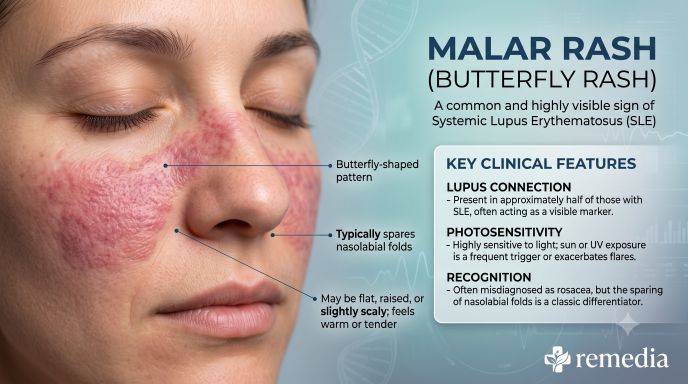
Don't self-treat a serious condition
Conditions like this deserve a doctor's eye. Start an online consultation and get a treatment plan suited to you.
Start ConsultationLupus is an autoimmune disease where symptoms may be strictly local and limited to the skin, or completely generalized with marked systemic involvement. No sharp line can be drawn between the different types, but they are broadly categorized into localized and systemic varieties. In autoimmune diseases like lupus, the body's immune system mistakenly attacks its own healthy tissues and organs, leading to widespread inflammation.
(A) Localized Lupus
The localized variety occurs in three distinct forms:
1. Chronic Discoid Type This is the most common localized variety. It primarily affects women around 40 years of age.
Lesions: Occur most frequently on the face, assuming a "butterfly" distribution, or persist as discrete discoid (coin-shaped) patches. The scalp may also be involved.
Progression: A sharply defined plaque of congestive erythema (redness) is covered by scales. Underneath these scales, small plugs extend into enlarged hair follicles. As congestion subsides, atrophic scarring and telangiectasia become evident. Slow or rapid centrifugal extension (spreading outward) may occur.
Clinical Note on Telangiectasias: These are small dilated blood vessels near the skin or mucous membrane surface, measuring 0.5 to 1 mm in diameter. They appear on the face (nose, cheeks, chin) and legs (upper thigh, below the knee, around ankles). Some are due to developmental abnormalities mimicking benign vascular neoplasms and consist of abnormal aggregations of arterioles, capillaries, or venules. Because they are vascular lesions, they naturally blanch when tested with diascopy (applying pressure with a glass slide).
2. Acute Localized Edematous Type Lesions present as circumscribed edematous (swollen) plaques. These may completely disappear or eventually develop into chronic discoid lesions.
3. Chronic Disseminated Type Numerous extensive lesions of the chronic discoid type are present, but systemic symptoms remain slight or entirely absent.
(B) Systemic Lupus Erythematosus (SLE)
Also known as Disseminated Lupus Erythematosus, SLE may follow discoid or other local skin lesions, but much more commonly starts as a generalized disease. Diagnosis of SLE relies heavily on clinical symptoms combined with specific blood tests, such as positive Antinuclear Antibodies (ANA) and anti-dsDNA tests. The natural course of SLE is subject to spontaneous remissions. Manifestations vary across different organs:
Joints & Muscles: Joint pain is the initial complaint in 90% of patients. This ranges from general aching of joints and muscles (resembling fibrositis), a migratory form of polyarthritis, or a chronic form hardly distinguishable from rheumatoid disease.
Constitutional Symptoms: A severe disturbance follows, featuring high evening temperatures, profuse sweating, and loss of appetite and weight.
Blood Profile: Anemia is usually noticed, accompanied by a polymorph leucopenia (low white blood cell count). Sometimes a severe hemolytic anemia arises.
Skin & Hair (Late Stage): Purpura (blood spots), petechiae, oral ulcers, and rashes resembling lichen planus or psoriasis. Alopecia areata (hair loss) may also occur.
Lymphatic System: Enlarged, sometimes tender superficial lymph glands, occasionally associated with liver and spleen enlargement.
Respiratory System: Pleurisy often occurs (large effusions are rare). Pulmonary infiltration and consolidation can cause severe dyspnoea (shortness of breath).
Cardiovascular System: Myocardial damage leading to heart enlargement and failure, pericarditis, or endocarditis. Vascular occlusion in the fingers causes Raynaud's phenomenon, and on occasion, local gangrene.
Renal System: Albuminuria, microscopic hematuria, and renal casts. The onset of edema and later uremia are always of serious, life-threatening significance.
Nervous System: Epileptiform convulsions, hemiplegia, and psychoneurosis, primarily resulting from vascular damage to the brain.
Gastrointestinal Tract: Abdominal pain, nausea, and vomiting.
Antiphospholipid Syndrome (APS)
Antiphospholipid syndrome, also known as "sticky blood," is an autoimmune disorder where the body makes antibodies against its own blood proteins.
Primary APS: Occurs in individuals without any other associated disease.
Secondary APS: Occurs alongside systemic lupus erythematosus (SLE) or another autoimmune disorder.
Prevalence: APS antibodies are found in up to 50% of people with lupus and in about 1-5% of the general population. It most commonly strikes young to middle-aged adults but can begin at any age.
Symptoms & Complications
The body begins producing blood clots that can block arteries and veins, cutting off the blood supply to various body parts. When blood clots form in the deep veins of the legs, it is clinically referred to as Deep Vein Thrombosis (DVT), a condition that carries the risk of the clot traveling to the lungs.
Limbs (Veins/Arteries): Pain, swelling, numbness, tingling in hands/feet, or leg ulcers. Complete loss of blood supply can lead to the amputation/loss of an extremity, such as a toe.
Heart (Arteries): Chest pain or heart attacks. Heart murmurs or valve problems are also common.
Skin (Blood Vessels): Bruises (purpura) or a blotchy, bluish rash known as livedo reticularis.
Brain (Blood Vessels): Strokes (if a clot cuts off brain blood supply), migraine headaches, or seizures.
Pregnancy (Placenta): Frequent miscarriages or premature births.
Catastrophic APS: A severe, life-threatening form where many internal organs develop blood clots simultaneously over a period of days to weeks.
Conventional Treatment
With standard medication and lifestyle modifications (like avoiding long periods of inactivity to prevent leg clots), most people with primary APS lead normal, healthy lives. Those with secondary APS may face additional complications from their underlying rheumatic or autoimmune conditions.
Homeopathic Therapeutics for Lupus, Hemorrhage, and Complications
In homeopathic practice, remedies are selected based on the Law of Similars ("like cures like"). The practitioner matches the highly specific physical, emotional, and modal symptoms of the patient to the remedy, rather than prescribing based solely on the pathological diagnosis.
Remedies for Gangrene & Tissue Degeneration
Arsenicum Album: Indicated for dry gangrene in older people. Features soreness and burning in the affected parts. Modalities: There is great relief from warmth. (Hemorrhages may also be due to tissue degeneration).
Secale Cornutum: Indicated for the same kind of dry gangrene in old people, but with relief from cold applications. The patient is often wrinkled and scrawny, cold, and sometimes unconscious.
Carbo Vegetabilis: The primary remedy for carbuncles and boils that become gangrenous. Also covers hemorrhages due to tissue degeneration.
Remedies for Neurological Complications & Apoplexy
Opium: Indicated by rattling, stertorous (noisy/labored) breathing, a very dark red face, tetanic rigidity of the body, and paralysis. The darker red the face, the more strongly it is indicated.
Arnica Montana: Used when there is an aching soreness all over the body, and bedsores form readily. Covers paralysis (especially on the left side) with a full, strong pulse and stertorous breathing.
Gelsemium: For threatened apoplexy with a generally relaxed state of the system, severe weakness, and trembling. The muscles refuse to obey the will.
Belladonna: Used early when effusion is attended with symptoms of violent congestion. Pupils are dilated, face is flushed, and carotids are throbbing.
Convulsion Accompaniers: When convulsions accompany the clinical picture, Belladonna, Hyoscyamus, and Lachesis should be considered.
Remedies for Hemorrhage (Vascular Symptoms & Hemoptysis)
Phosphorus: Suits the hemorrhagic diathesis where blood does not coagulate. Indicated for hemoptysis (coughing blood) and hematemesis (vomiting blood), or hemorrhages from any part of the body (especially lungs or stomach).
Secale Cornutum: Passive, painless flow of dark liquid blood. Hemorrhages are often preceded by formication (crawling sensation) and tingling. Modalities: The slightest motion aggravates the flow.
Cinchona (China): Dark, clotted hemorrhages from any body part. Accompanied by coldness of the face, collapse, gasping for breath, ringing in the ears, and a strong desire to be fanned.
Carbo Vegetabilis: Copious passive hemorrhage where the patient desires to be fanned. Persistent, dark nosebleeds in old, debilitated persons with pale, sunken, almost hippocratic faces.
Acalypha Indica: Features a dry cough followed by spitting of blood. Blood is pure in the morning, but dark, lumpy, and clotted in the evening, accompanied by a constricted feeling around the chest.
Sabina: Metrorrhagia (uterine bleeding) with a paroxysmal flow of bright-colored blood, accompanied by joint pains. Frequently used after abortion or labor when pains extend from the back to the pubis.
Ipecacuanha (Ipecac): Bright red blood flowing steadily or in gushes. Specifically for hemoptysis accompanied by severe nausea and gagging.
Lachesis: Hemorrhages of dark blood that deposits a sediment looking like charred straw. Small wounds bleed profusely, and the blood remains fluid without coagulating.
Belladonna: Hemorrhage is bright red from the uterus and is characteristically hot.
Bovista: Hemorrhages stemming from relaxation of the capillary system (epistaxis or menstrual flow). Blood flows with very little exertion. Modalities: The flow occurs more frequently at night or in the morning.
Ustilago: Bright, partly dotted hemorrhages resulting from passive congestion of the uterus. Hemorrhages trigger from slight causes, such as digital examinations.
Millefolium: Bright red hemorrhages from any body part, especially occurring after mechanical injuries. Covers hemoptysis, epistaxis, or uterine/bowel hemorrhages. Distinctive feature: No fever and no anxiety (unlike Aconite).
Erigeron: Bright red hemorrhage that is increased by every single motion the patient makes.
Aconite: Bright red hemorrhage accompanied by great anxiety and fever.
Cinnamomum: Profuse hemorrhage triggered by a strain or a misstep. Covers a general tendency to hemorrhages and frequent attacks of nosebleed.
Trillium Pendulum: Active or passive bleeding, notably in threatened abortion. Features a gush of blood with every movement and a distinct sensation as if the hips and back were falling apart. Modalities: Relieved by bandaging the hips tightly.
Mercurius: Epistaxis (nosebleed) where the blood rapidly coagulates and hangs from the nose like icicles.
Ferrum Metallicum: Functionally stands between China and Ipecac. Suits anemic, highly prostrated cases (like China) but features a bright red, gushing flow with difficulty breathing (like Ipecac).
Hamamelis: The flow is dark, passive, venous, and accompanied by a distinct feeling of soreness. The patient feels greatly exhausted.
Cactus Grandiflorus: Hemoptysis with strong, throbbing action of the heart. Features less fever and anxiety compared to Aconite.
Crocus Sativus: Epistaxis or other hemorrhages where the blood is notably thick and dark, hanging in long strings from the nose or wound.
Don't self-treat a serious condition
Conditions like this deserve a doctor's eye. Start an online consultation and get a treatment plan suited to you.
Start Consultation
Medically reviewed by
Dr. Gupta · B.Sc. GHMS
Senior Homoeopath with 40+ years of field experience
View full profile →